|
Splendor of Fluids in Motion
The world first flow
visualization representation below is a sketch of a free water jet
issuing from a square hole into a pool, drawn by the hands of Leonardo
da Vinci; circa 1500. In the view of John L. Lumley, da Vinci might
have prefigured the now famous Reynolds turbulence decomposition nearly
400 years prior to Osborne Reynolds' own pipe-flow visualization! In
one of his notebooks, da Vinci wrote (translated by Ugo Piomelli):
"Observe the motion of the surface of the water, which resembles that
of hair, which has two motions, of which one is caused by the weight of
the hair, the other by the direction of the curls; thus the water has
eddying motions, one part of which is due to the principal current, the
other to the random and reverse motion." For more details, click
here.

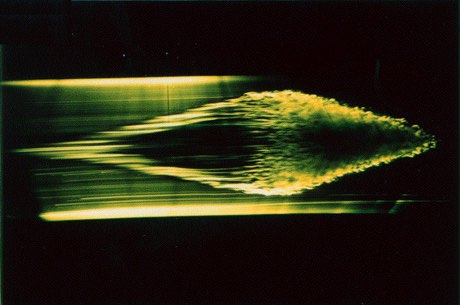
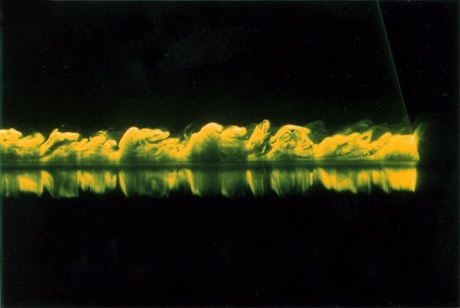
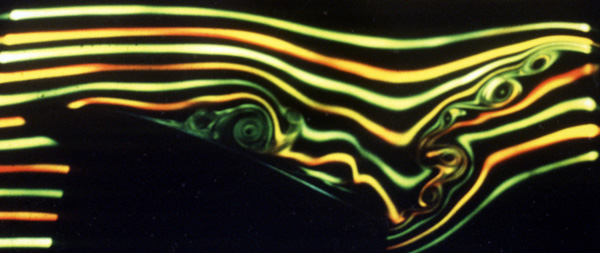
The three photographs below were
taken close to five centuries after that of da Vinci. The first one
depicts a top view of a turbulent spot growing by destabilizing the
surrounding laminar (vortical) flow. The second is a side view of the
large eddies in a turbulent boundary layer. And the last one is a side
view of a lifting surface undergoing a pitching maneuver. The top
picture was the first to appear in an archival publication (Journal of
Fluid Mechanics, vol. 110, p. 73, 1981) showing the utility of flow
visualization via laser-induced fluorescence (LIF), a technique which
is now widely used around the world for detailing the anatomy of
three-dimensional flow fields.
|


